A Faster, Cheaper Way To Give Solar Panels A Clean Bill Of Health
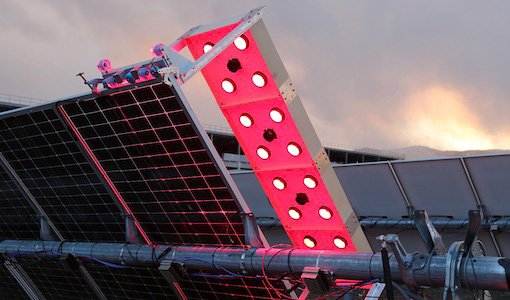
In the Darkness of Night, NREL Is Prototyping a New Device That Could Cut Time and Costs for Inspections of Solar Installations After Potentially Damaging Weather

After severe weather events—like hail or major windstorms—fielded solar panels should be inspected for damage, usually with either complex electrical equipment or by removal for indoor lab testing. Often, these inspections reveal minimal damage but still require system downtime and high costs to confirm their health.
A new system, developed by National Renewable Energy Laboratory (NREL) photovoltaic reliability researchers with input from industry partners, simplifies and streamlines this process by relying on photoluminescence—a fundamental property of the semiconductors in solar cells. The PLatypus device shines light on the solar cells, which then re-emit light back to the device’s cameras. Damaged cells will shine less brightly, quickly indicating the health of the panels.
An entire system can be checked at a fraction of the time and cost previously required—all without any disconnection of the system’s electronics. The PLatypus device is under development as part of the Durable Module Materials Consortium (DuraMAT), funded by the U.S. Department of Energy Solar Energy Technologies Office and led by NREL.
Article from NREL, by Harrison Dreves.
I don’t like paywalls. You don’t like paywalls. Who likes paywalls? Here at CleanTechnica, we implemented a limited paywall for a while, but it always felt wrong — and it was always tough to decide what we should put behind there. In theory, your most exclusive and best content goes behind a paywall. But then fewer people read it! We just don’t like paywalls, and so we’ve decided to ditch ours.
Unfortunately, the media business is still a tough, cut-throat business with tiny margins. It’s a never-ending Olympic challenge to stay above water or even perhaps — gasp — grow. So …